
Maryland Background Check Records
Maryland background check records are available through several official state systems. The Criminal Justice Information System, known as CJIS, is the state's main database for criminal history records and is run by the Department of Public Safety and Correctional Services. You can also search court records for free through the Maryland Judiciary Case Search portal, which is open to the public any time. This guide covers how to find and use Maryland background check records through CJIS, county circuit courts, state archives, and other official sources across the state.
Maryland Background Check Overview
Maryland CJIS Background Check System
The Department of Public Safety and Correctional Services runs the Criminal Justice Information System, or CJIS, in Maryland. This is the official state database for criminal history. CJIS keeps Maryland's fingerprint-supported criminal identification records at its Central Repository in Pikesville. All official Maryland background check requests must go through this system. The courts' Case Search tool is not meant for background checks. The state makes this very clear on the official CJIS page at dpscs.maryland.gov/publicservs/bgchecks.shtml.
The CJIS Central Repository is at 6776 Reisterstown Road, Suite 102, Baltimore, MD 21215. Mail requests go to CJIS-CR, P.O. Box 32708, Pikesville, MD 21282-2708. The call center handles inquiries at 410-764-4501 for Baltimore City local calls or toll-free at 1-888-795-0011. CJIS Customer Service cannot disclose criminal history over the phone. They can only confirm the status of a pending request when you provide a reference number or Social Security number. Processing takes 10 to 15 days from the date CJIS receives your submission.
Fee tiers vary based on who is requesting and why. A state-only Maryland background check costs $18 by mail or $38 in person. A full check that includes both state and FBI records costs $30 by mail or $50 in person. Child care volunteers pay $28 by mail or $48 in person for a full check. There is a $20 fingerprint service fee per customer in addition to the background check fee. Payment at the Central Repository must be by credit card only. No cash, checks, or money orders are accepted there. Visa, MasterCard, and Discover are all accepted.
The Maryland CJIS background check page also notes the Gold Seal option, which adds $1 to the state-only check fee for an official certification seal. This is used for adoptions and some licensing applications in Maryland. Each fingerprinting site collects both the CJIS fee and the FBI fee where applicable. Private providers may charge additional processing fees on top of those amounts.
The CJIS background check page on the DPSCS website details all fee tiers, required forms, and fingerprinting site information for Maryland. Visit the link above to get started or to download the necessary forms before your appointment.
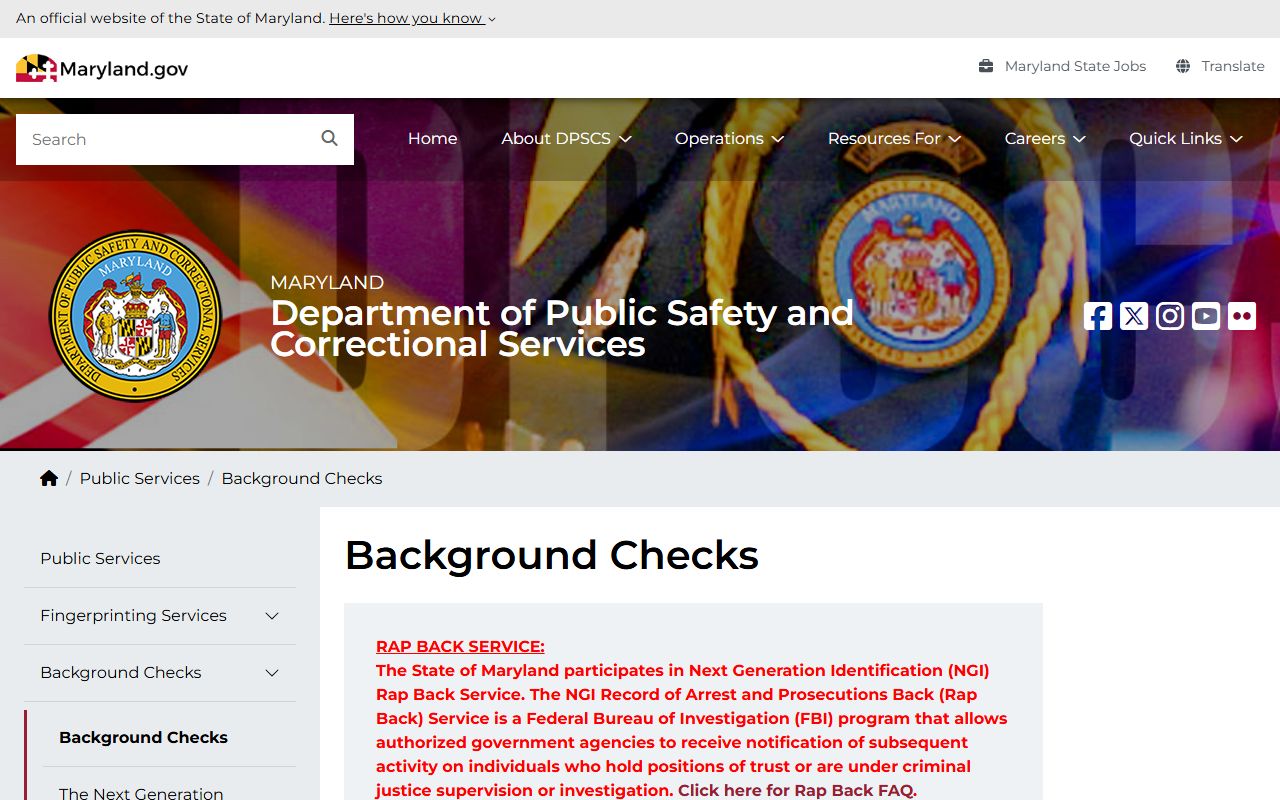
The page above shows the DPSCS CJIS background check portal. It lists every fee tier, explains who can request what type of check, and provides the forms needed to submit a request in Maryland.
Fingerprinting for Maryland Background Checks
All official Maryland background checks require fingerprinting. As of October 1, 2020, all in-state applicants must use LiveScan inkless electronic fingerprinting units. The old ink-and-roll hard-card method is accepted only when a bona-fide medical reason prevents LiveScan from working. If you are getting a background check for licensing, you must give the agency's name and authorization number at the time of fingerprinting. Government agencies may also need a Z-ORI number. You must bring a valid government-issued photo ID.
You must print and bring a LiveScan Pre-registration Application before going to be fingerprinted. This form is required at the time of your appointment. Fingerprinting sites are spread across Maryland at both private providers and government-operated locations. Private providers may charge extra processing fees on top of the CJIS rates. CJIS recommends calling providers directly for their current fees before you go. Popular facilities near major defense contractors and government centers in the Baltimore-Washington corridor book up weeks ahead. Schedule early if you have a deadline.
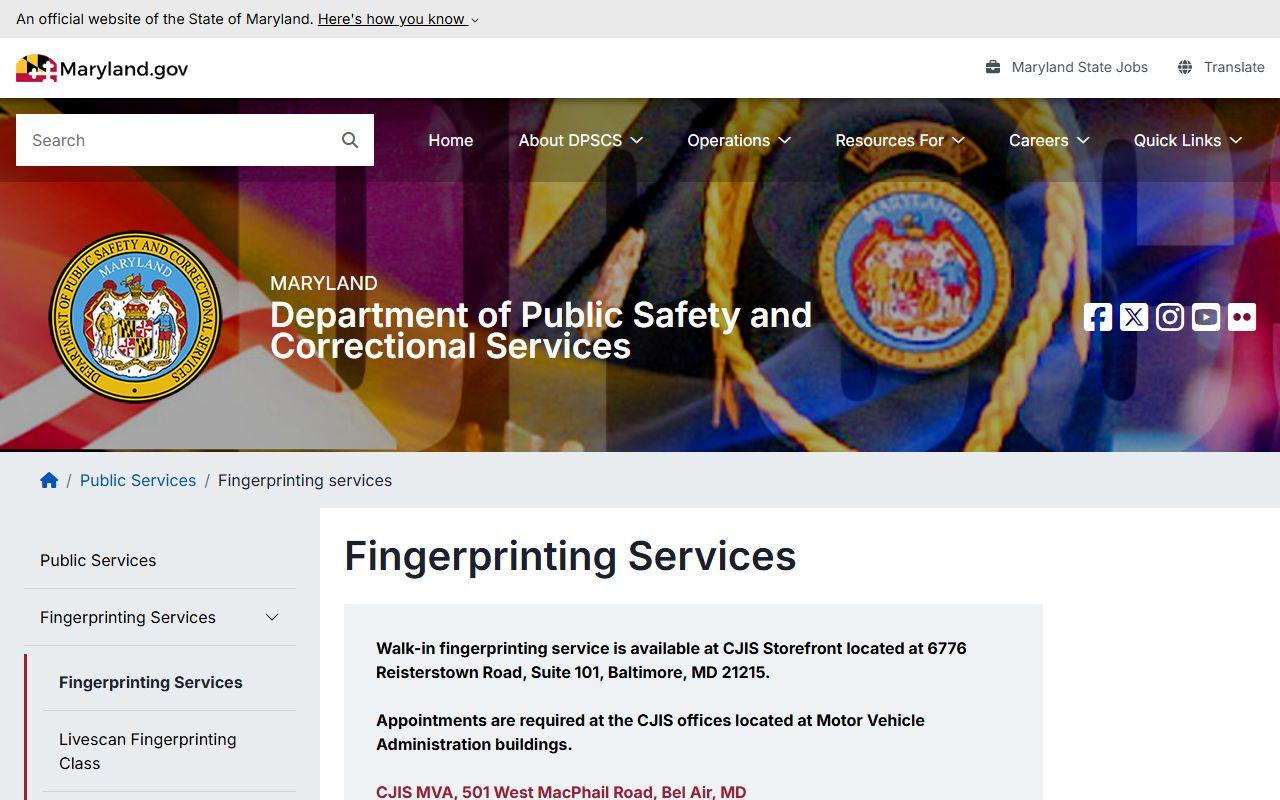
The screenshot above shows the Maryland DPSCS fingerprinting services page at dpscs.maryland.gov/publicservs/fingerprint.shtml. This page lists authorized fingerprinting sites and explains what to bring to your appointment.
Five CJIS MVA locations offer state fingerprinting services in Maryland. They are in Bel Air at 501 W MacPhail Road, Frederick at 1601 Bowman's Farm Road, Glen Burnie at 6601 Ritchie Highway, Salisbury at 251 Tilghman Road, and Waldorf at 11 Industrial Park Drive. These are government-operated sites that accept the standard CJIS fee structure. Outside of these five MVA locations, many private providers operate throughout the state.
Maryland Judiciary Case Search
The Maryland Judiciary Case Search portal is the main public tool for searching court records online. It is free, requires no registration for basic use, and is available 24 hours a day. You can search Circuit Court civil and criminal cases, District Court civil, criminal, and traffic cases, and appellate court cases going back several years. The system is accessible at casesearch.courts.state.md.us/casesearch. Records are updated within about 10 minutes of a clerk's entry, making the data near real-time.
The portal was first launched in January 2006 and was redesigned on February 5, 2024. Chief Justice Matthew J. Fader said the redesign was one way the courts honor their mission. The new design places the most searched fields first and makes advanced options expandable only when needed. Search options include party name, case number, citation number, and filing date range. You can also filter by court system and case type. The system defaults to exact-name searches. To search partial names, type at least the first letter of the last name followed by a percent sign (%). You cannot place the percent sign at the start or middle of a word.
Case Search shows summary data only, not document images. Summaries include party names, charges, hearing dates, case status, and dispositions. Some records are intentionally excluded. Juvenile cases, sealed records, expunged records, cases that ended in nolle prosequi, dismissal, or acquittal, and stet cases older than three years do not appear. Single cannabis possession charges disposed of before July 1, 2023 are also excluded. Governor-pardoned cannabis convictions are excluded as well. For records that no longer appear on Case Search, you may still be able to view them in person at the courthouse. More detail is available in the Case Search FAQ.
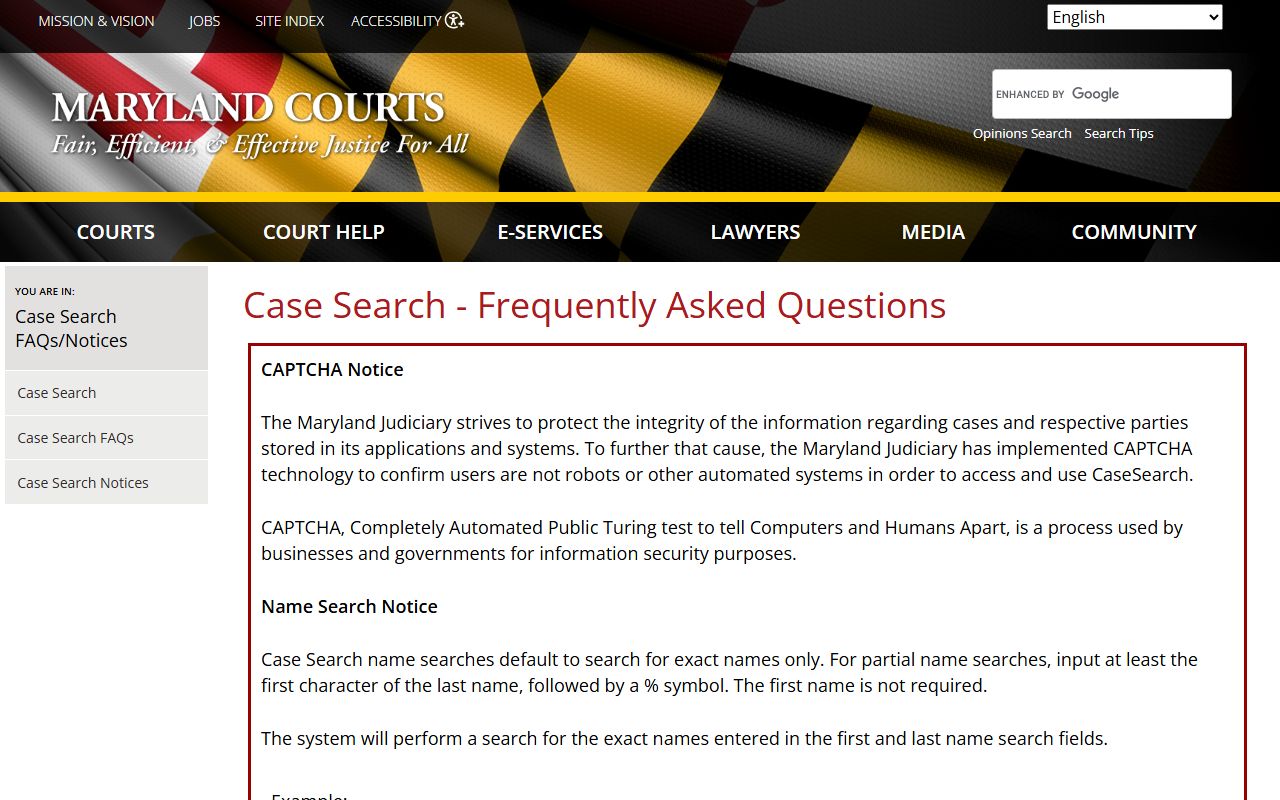
The Case Search FAQ page shown above explains what is and is not included in search results, how to use wildcard searches, and what to do when you cannot find a record you are looking for. Bookmark this page if you search Maryland court records often.
Note: Maryland courts state clearly that Case Search should not be used for background checks. Use CJIS for any official criminal background check in Maryland.
Accessing Court Records in Maryland
Court records in Maryland are generally open to the public. Anyone can view them in person at the clerk's office in the county where the case was heard. You do not need to be a party to the case. Physical records are stored at the courthouse that handled the case. The Maryland courts' legal help page at courts.state.md.us/legalhelp/courtrecords explains what is open, what is restricted, and how to access records in person or online.
Certain records are not open to the public without a court order. These include adoption cases, guardianship cases that end parental rights, juvenile delinquency cases, and child-in-need-of-assistance cases. Emergency mental health evaluations, income tax returns filed in court, and financial statements in support cases are also off limits. Some documents are automatically kept private by law without any separate request needed. If a document you filed contains restricted information like a Social Security number or a tax return, you must notify the court.
Maryland courts use the MDEC electronic filing system. Attorneys must file electronically in most Maryland courts. For parties in active cases, MDEC provides access to filed documents online. The public gets summary data only through Case Search. If you need a full document from a case, you must visit the clerk's office in person or submit a written mail request. Certified copies cost $5 plus $0.50 per page at most Maryland circuit courts. A plain copy without certification is $0.50 per page. Mail requests to most clerks require a self-addressed stamped envelope and a $2 handling fee unless you provide the envelope. Call the clerk ahead of time to confirm what you need to bring and whether a case number is required.
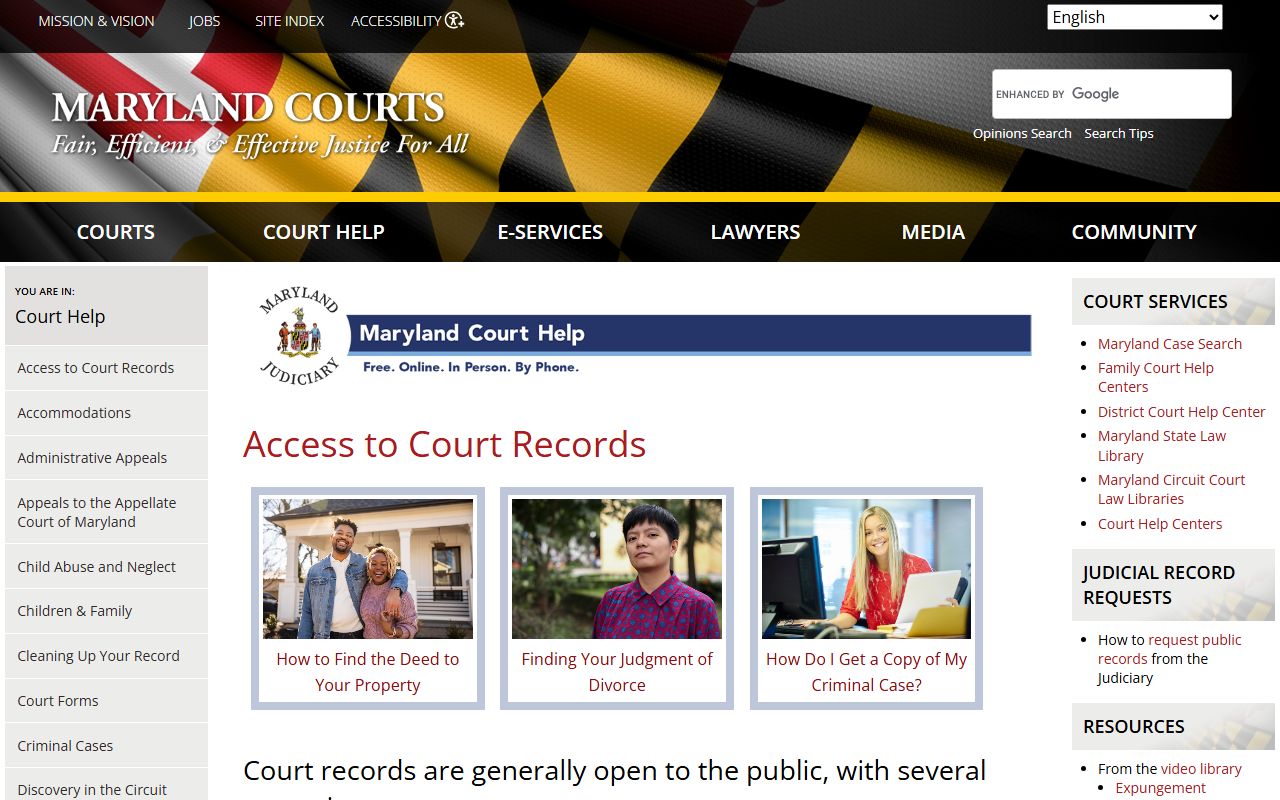
The page above covers all access routes for Maryland court records, including what is public, what is sealed, and the difference between what Case Search shows and what is in the full case file at the courthouse.
Maryland State Archives Records
The Maryland State Archives stores older court case records from all 24 jurisdictions. If the courthouse no longer holds the records you need, the Archives may have them. The Archives is at 350 Rowe Boulevard, Annapolis, MD 21401. Phone is (410) 260-6400 or toll-free at 1-800-235-4045. You can also reach them by fax at (410) 974-2525 or email at msa.helpdesk@maryland.gov.
Two order forms are available online. Use the County Court Case Order form at shop.msa.maryland.gov to request an entire court case file for $50. Use the Criminal Disposition Order form at shop.msa.maryland.gov to request just a specific charge disposition or docket entry for $25. If you only need the disposition document, the $25 form is the right one. Both fees are non-refundable and non-transferrable. For a full case, you can also request a specific part of the file for $35. All government-created criminal disposition documents come certified.
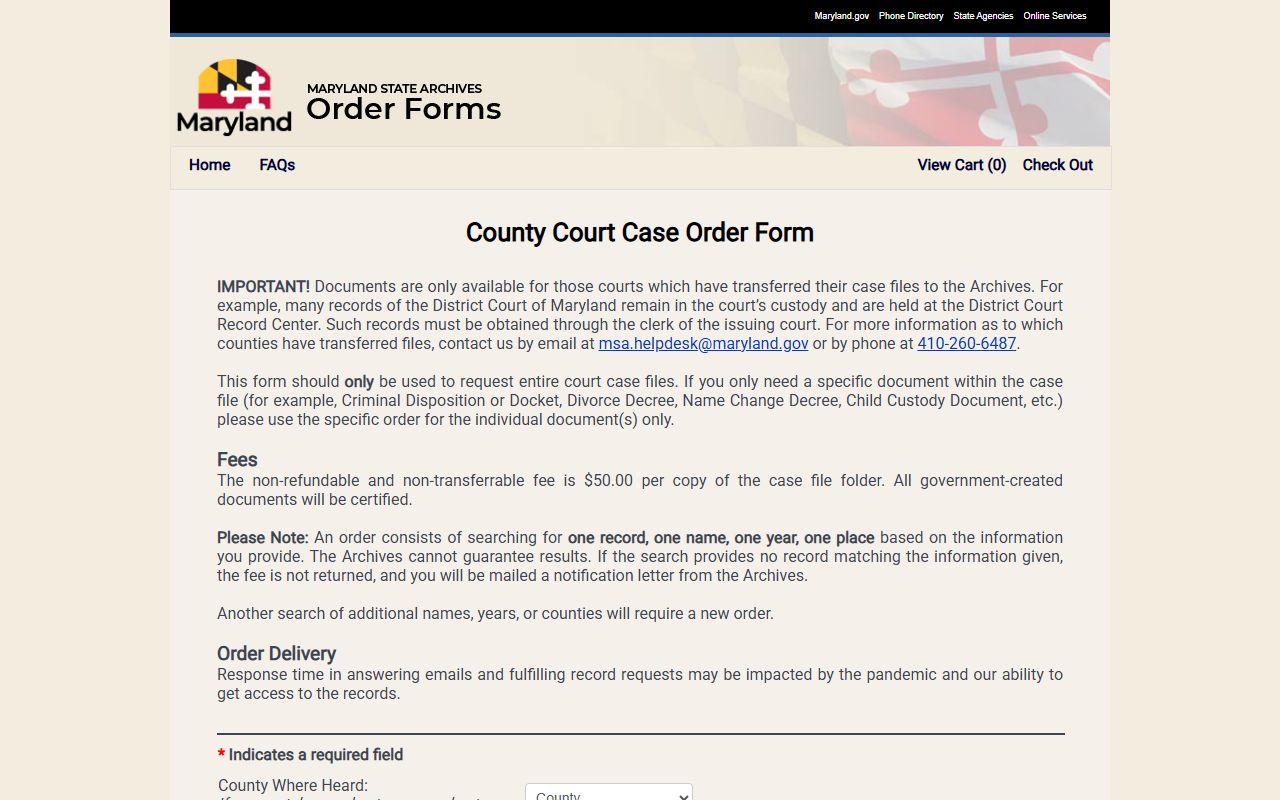
The Court Case Order form above is for requesting full case files. Fill in the type of court, type of case, dates, and the names of the parties. If you are not sure of exact dates, provide your best estimate and note it in the Additional Information field. A guide to government records held at the Archives is available at http://guide.mdsa.net.
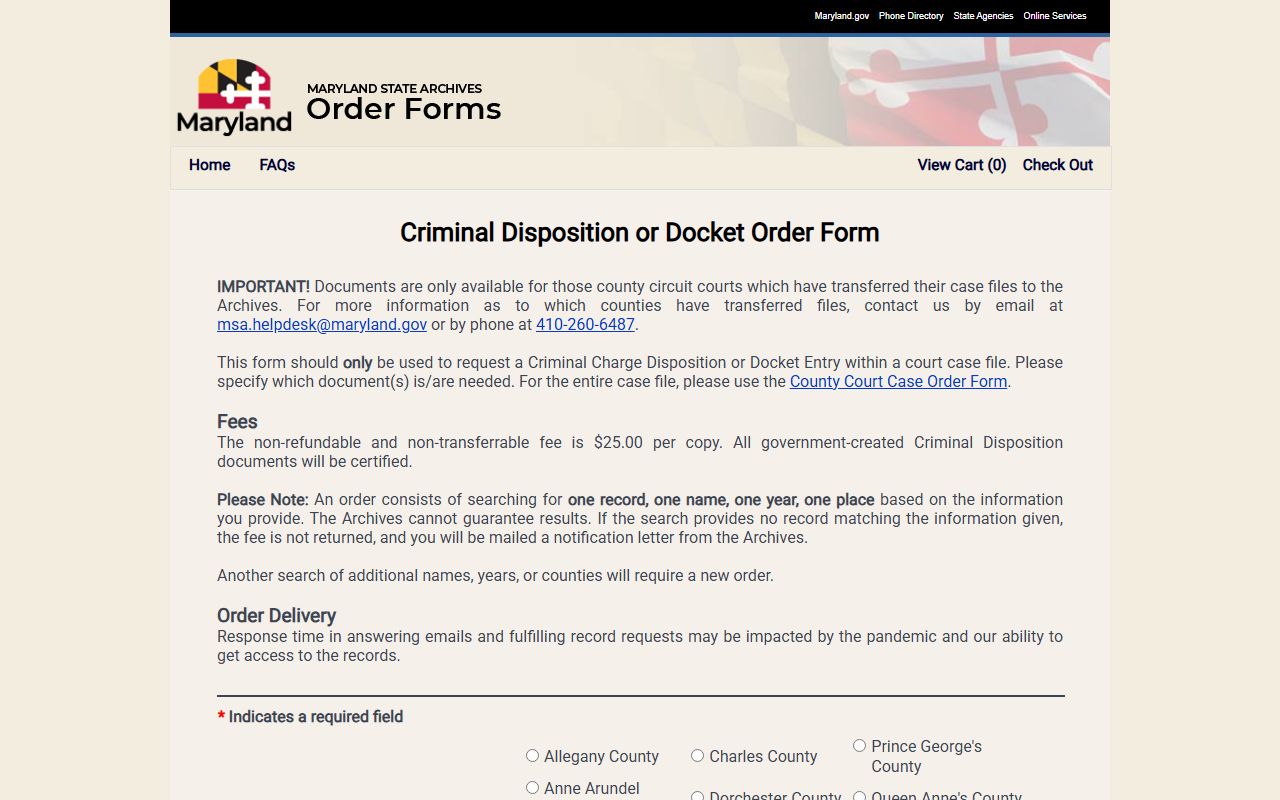
The Criminal Disposition Order form shown above is for single documents within a case file. It includes checkboxes for expungement and Governor's pardon inquiries. Pay by credit card when possible. If paying by check, write "not to exceed" and an amount since exact page counts may vary.
Maryland Sex Offender Registry
Maryland's public Sex Offender Registry is maintained by the Department of Public Safety and Correctional Services. You can search it online at socem.info by name, zip code, or location. The registry lists individuals required by Maryland law to register as sex offenders. Checking the registry is free and does not require an account.
The sex offender registry is separate from the CJIS criminal history system. Searching it gives you only current registrant information and does not produce a complete Maryland background check. For a full criminal history, you still need to submit a fingerprint-based request through CJIS. The registry is a useful starting point, but it covers only those required to register under state law.
Record Shielding and Expungement in Maryland
Expungement removes information from court and law enforcement records in Maryland. If a charge has been expunged, it will not show up through CJIS or on Case Search. However, even if a charge was expunged from FBI records, it can still remain on Maryland's own CJIS records in some cases. This matters when you check your own criminal history through the state system.
Maryland's Second Chance Act allows shielding of certain convictions. Shielded records stay accessible to law enforcement but are hidden from the public on Case Search. Failure to Pay Rent cases filed during the COVID-19 period between March 5, 2020 and January 1, 2022 can be shielded using form DC-CV-116. Cases filed on or after October 1, 2024 that ended in a possession judgment can be shielded after 12 months if the tenant exercised the right of redemption. Cases that did not end in a possession judgment are auto-shielded within 60 days under current Maryland rules. Contact the clerk's office in the county where your case was heard to ask about your options for expungement or shielding.
Browse Maryland Background Check Records by County
Each of Maryland's 23 counties and Baltimore City maintains court records through the Circuit Court Clerk. Pick a county below to find local contact information, fees, and background check resources for that area.
Maryland Background Check Records by City
Background check and criminal record resources in major Maryland communities are handled through county courts and local law enforcement. Pick a city below to find resources for that area.